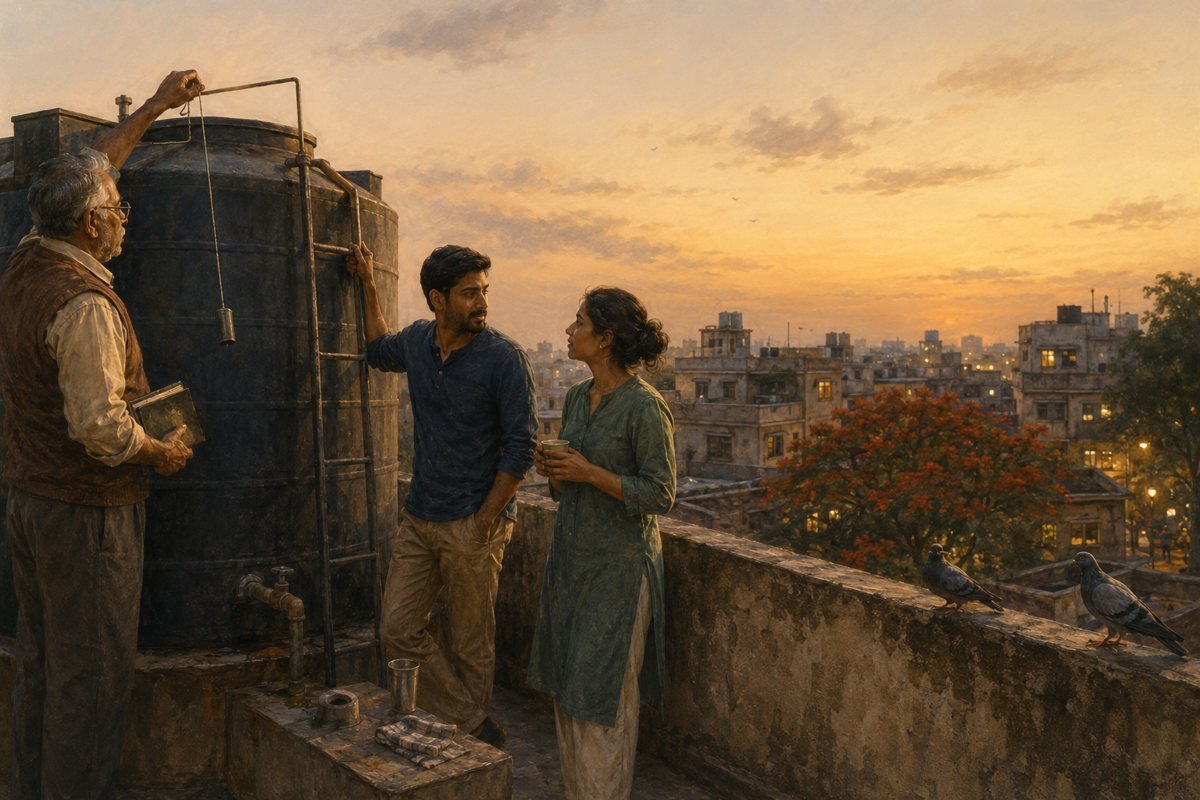
Meera and Sameer moved into the third-floor flat the month Myra turned four. The building was old enough to have a name instead of a number — Chandan Heights, eleven families, a gulmohar in the courtyard — and a terrace where pigeons held their morning meetings. Myra liked the pigeons. Meera liked the light. Sameer liked that the EMI was, in his words, "tight but honest."
Every morning, before the milk van came, Mr. Kulkarni climbed to the terrace. He was the society's oldest resident and its self-appointed keeper of the water tank — a large black cylinder on the roof that everyone drank from and nobody thought about. He would open the lid, lower a steel dipstick on a string, and note the level in a small diary that had survived three monsoons.
One Sunday, waiting for Myra to finish negotiating with the pigeons, Meera asked him, mostly to make conversation: "How big is the tank, kaka?"
"Wrong question," he said, without looking up from the diary. "I stopped measuring in litres years ago. I measure in days. If the municipal line fails this morning, this building lives for four days. Cooking, bathing, Myra's water bottle — four days." He tapped the black cylinder and pointed toward the road. "The pipe is not your water supply, beta. The pipe fills the tank. The tank runs the house."
Meera smiled the way you smile at old men and their systems, took Myra's hand, and went down to breakfast.
Their money, in those years, moved like municipal water: it arrived on the first of the month and it flowed. Sameer was a product manager at a startup that was going places; Meera had gone independent — design work, invoiced project by project — so she could be home before Myra's school van. They were careful people. They had SIPs running for Myra's future. They had insurance. The EMI left on the fifth, the school fees left in June, and whatever remained by the twenty-eighth was quietly absorbed by the ordinary genius of family life.
The pipe was generous. So no one thought about the tank.
The email came on a Tuesday in March, and it was polite. The funding round was "taking longer than anticipated." Salaries would be deferred by sixty days. The leadership was confident. Everyone appreciated everyone's patience.
It was not a job loss. It was a pause. That is what Sameer kept saying, and he was right. But the EMI did not pause. The school's term fee did not pause. His mother's medicines, the gas cylinder, the van fees — none of them had read the email.
That fortnight, Meera and Sameer discovered the exact shape of their money. Some of it lived in the pipe — next month's salary, a client invoice due "shortly." Some of it lived deep underground — the SIPs, growing beautifully for a future fifteen years away, guarded by the feeling that breaking them would be breaking something of Myra's. Between the pipe and the well, there was nothing. No tank. The card carried the groceries that month, at the card's usual price.
One evening Meera went up to the terrace alone, the way you do when the kitchen table has too much arithmetic on it. The tanks of the neighbourhood stood on their rooftops in the last light, patient and unglamorous. Mr. Kulkarni was at his post, dipstick in hand, noting the level of water nobody had needed that day.
She stood there long enough for the streetlights to come on. Four days, she thought. He can tell you to the day. And I don't know our number at all.
They got through it, the way families do. They told each other the truth at the kitchen table, after Myra slept — the whole truth, with the calculator, which was somehow easier than the halves they had been telling. They paused one SIP for two months; it felt like a betrayal and was actually a decision. Meera took a project she would normally have declined. On day sixty-three, the salaries arrived, all of them, with a graceful apology. This is not a story about a family failing. By every measure, they had managed.
But the Sunday after the first full salary, they did something new. They opened a separate account at the same bank. The form asked for a nickname for the account, and Sameer, without consulting anyone, typed Tank.
Then they did what Mr. Kulkarni had done years ago: they stopped measuring in litres. They sat down and worked out, for the first time in eight years of marriage, what one month of their life actually cost — not the salary, the life: EMI, school, food, van, medicines, the quiet subscriptions. The number surprised them both. Then they chose their level not in rupees but in months — six, they decided, because one income was steady, one was seasonal, and one member of the household was four years old — and set a standing instruction for salary day, before the month could get to the money first.
The following summer, a pipeline burst near the highway and the municipal supply failed for four days — a small city-wide adventure. Chandan Heights did not particularly notice. On the second evening, Myra reported at dinner, with great authority, that Kulkarni-kaka said the building could drink for two more days and that she was to take a shorter bath anyway, on principle.
"And what if it takes longer than that?" Sameer asked her, teacher-voiced.
Myra thought about it. "Then we'll use it slowly," she said. "That's what a tank is for."
Across the table, Meera caught Sameer's eye. Their own tank stood at a little over three months now — invisible, unglamorous, filling the way tanks fill: from ordinary mornings, one salary day at a time. Nobody claps for it. It isn't for clapping.
It's for the morning the pipe goes quiet.